Faceless content is one of the fastest-growing formats in the creator economy — and for good reason. Channels built entirely on narrated visuals, text-on-screen explanations, or AI-generated scenes are scaling to hundreds of thousands of subscribers without a single on-camera appearance. No face, no location, no expensive setup.
The appeal is obvious: lower barrier to entry, stronger privacy, and a content format that can be produced at volume. The bottleneck, historically, has been production time. Turning a written script into a watchable faceless video used to require sourcing stock footage, cutting a timeline, syncing narration, adding captions — hours per video.
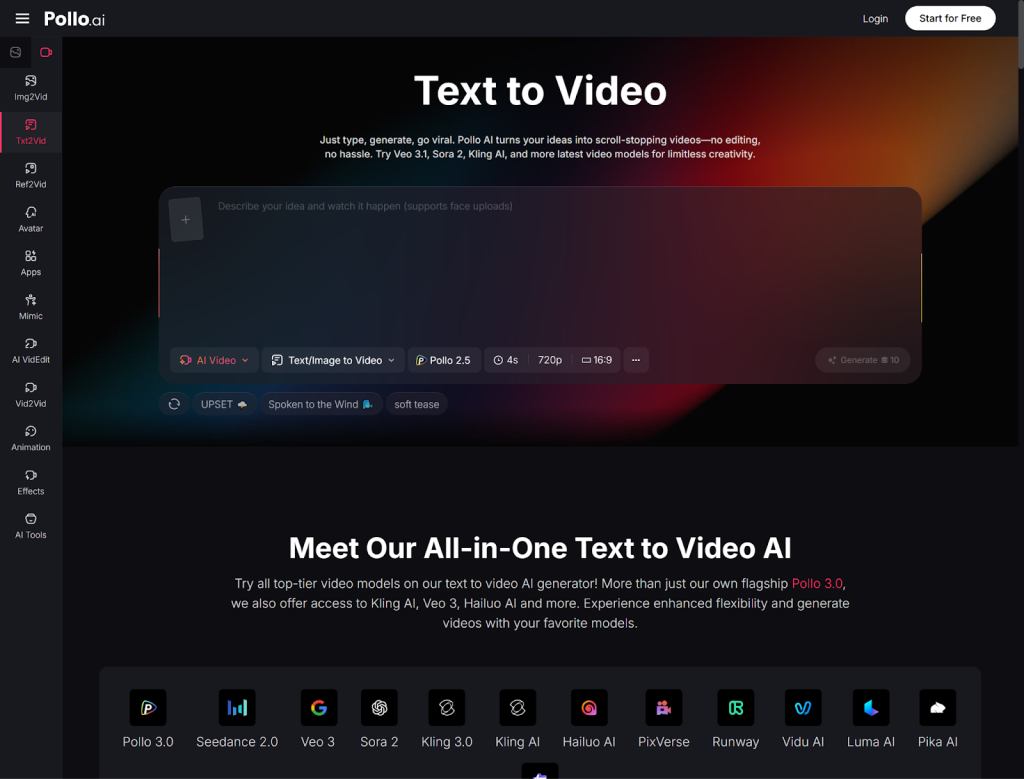
The Pollo AI text to video workflow changes that. Input your script, select your visual style, and Pollo AI generates the complete video — scenes, pacing, captions — without any manual assembly. For faceless content creators, this is the workflow that makes posting at scale genuinely sustainable.
1. Why Faceless Videos Are Popular for Scalable Content
Three reasons faceless channels work:
Production efficiency: No camera, no lighting, no presenter prep. The entire production chain collapses to: write script → generate video → publish.
Content volume: Because production friction is so low, creators can publish more frequently. Higher posting frequency means more chances for algorithm amplification, faster audience growth, and more content to test.
Niche specialization: Faceless formats work exceptionally well for educational, motivational, historical, finance, and productivity niches — any topic where the information is more valuable than the personality delivering it.
The channels that are growing fastest in this space aren’t lucky — they’ve found the right workflow. AI generation is now a core part of that workflow.
2. What a Good Faceless Script Looks Like
The script is the most important input in a faceless video. Because there’s no presenter to carry the viewer through awkward pauses or vague segments, the script has to do heavy lifting:
- Open with a hook: The first 5–10 seconds must answer “why should I watch this?” Give a specific promise: “In the next 90 seconds, you’ll learn the three things most people get wrong about X.”
- Write visually: Every sentence should suggest an image. Avoid abstract constructions like “there are many considerations.” Say instead: “Imagine you’re looking at two nearly identical products…”
- Keep sentences short: Long sentences are hard to pace in video. Aim for 15–20 words per sentence maximum.
- Build in transitions: Explicit transitions (“Here’s the second point,” “Now let’s look at…”) help viewers follow the structure without needing a visible presenter.
- End with a clear next step: What do you want viewers to do after watching? State it explicitly in the last 10–15 seconds.
3. Turn Scripts Into Scenes, Visuals, and Captions
With your script ready, the production workflow is:
- Segment your script by idea or beat — each H2 heading, each numbered point, each logical shift is a new scene.
- Paste your script into Pollo AI — the AI reads your text, selects or generates matching visuals, and builds the scene sequence.
- Review generated scenes — check that the visual content aligns with the meaning of each script segment. If a scene feels disconnected, adjust the prompt language for that segment and regenerate.
- Check captions — Pollo AI handles on-screen text, but verify readability: font size, timing, contrast against the background.
- Export and review the assembled video — watch it through once at the target pace, checking for any jarring transitions or scenes that don’t serve the script.
The full process for a 2–3 minute faceless video — once the script is written — can be completed in under 20 minutes.
4. Speed Up Production Without Losing Clarity
Speed is the advantage, but clarity is the product. Watch out for these quality killers that creep in when you’re moving fast:
- Generic visuals that don’t match the script: Pollo AI generates visuals from your text, but if your script is vague, the visuals will be too. Be specific in your scene descriptions.
- Too many cuts in a short span: Rapid scene changes can feel disorienting. Let important visuals breathe — 3–5 seconds per scene is usually appropriate.
- Weak or robotic voiceover: If your video uses TTS narration, choose a voice that matches your content’s tone (authoritative, conversational, energetic). A mismatched voice undermines the content.
- Rushing the hook: Spend at least 2–3 editing passes specifically on the first 10 seconds. That’s where viewers decide to stay or leave.

For creators who prefer more editorial control or who need specific visual styles that don’t emerge from generative models, DeeVid AI Video Generator offer scene-by-scene editing where you can swap in specific media or adjust timing at a granular level.
5. Compare AI Workflows for Different Content Goals
Not every faceless video needs the same kind of AI workflow:
- Pure text-driven generation (Pollo AI): Best for creators who start from a written script and want AI to generate all the visuals. Maximum speed, no footage required.
- Script + stock footage assembly: AI selects stock clips based on your script. Faster than manual sourcing, but visual library depth determines quality.
- AI narrator + background visuals: The script is delivered by an AI voiceover over generated or stock imagery — strong for educational and explainer content.
The trade-off: more control means more time spent per video. For most faceless content workflows, the speed of generative output from Pollo AI outweighs the granular control — especially when you’re publishing four or five videos a week.
6. Publishing Tips for Shorts, Reels, and TikTok
Faceless content performs well across all short-form platforms, but the platform context changes what you optimize for:
- YouTube Shorts: Longer retention is rewarded. Aim for 45–60 seconds with a clear narrative arc. Hook, three beats, CTA.
- Instagram Reels: Visual quality and first-frame imagery are critical. Make sure your opening visual is compelling before the play button gets pressed.
- TikTok: Speed and trend alignment matter. Faceless formats with trending audio, fast cuts, and bold on-screen text often outperform slower editorial styles.
With Pollo AI, you can generate versions of the same core script in different lengths and ratios — a 60-second version for Shorts, a 30-second cut for TikTok, all from one writing session. That kind of multi-platform efficiency is what separates channels growing at 1,000 subscribers a week from those stuck at fifty.
read more : https://seagreen-louse-169149.hostingersite.com/