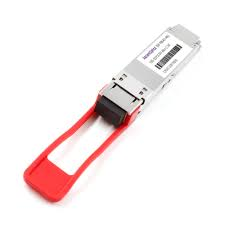
As cloud computing, AI services, and distributed storage continue to grow, data center interconnection (DCI) has become a fundamental part of modern network infrastructure. Enterprises and cloud service providers increasingly rely on multiple geographically separated data centers to support redundancy, disaster recovery, workload balancing, and low-latency service delivery. In metro-area environments, where facilities are often separated by tens of kilometers, 100G ER4 optical modules remain an important and highly practical solution.
Although newer coherent technologies such as 100G ZR and ZR+ are attracting attention, 100G ER4 continues to play a critical role in many metro DCI deployments because of its balance between reach, simplicity, power efficiency, and deployment cost.
Growing Demand for Metro Data Center Interconnects
Modern cloud architectures no longer rely on a single centralized data center. Instead, applications and workloads are distributed across multiple facilities within metropolitan regions. These data centers constantly exchange massive volumes of traffic, including virtual machine migrations, storage replication, database synchronization, and AI training data.
As east-west traffic between facilities increases, network operators require reliable high-bandwidth optical links capable of supporting long-distance transmission without introducing excessive complexity. Metro DCI networks typically require transmission distances ranging from 10km to 40km, making 100G ER4 an ideal fit for these scenarios.
The module’s ability to support 100Gbps transmission over single-mode fiber up to 40 kilometers allows operators to build high-capacity interconnections between urban data centers without relying on more complex coherent transport systems.
The Value of 40km Transmission
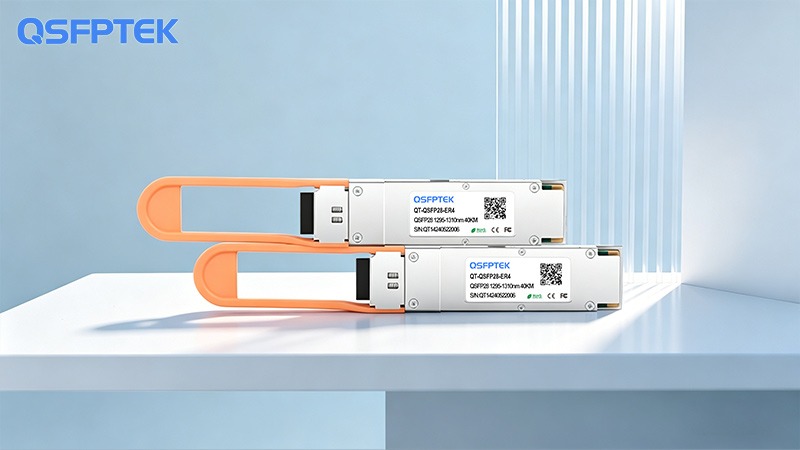
One of the most important advantages of 100G ER4 is its 40km transmission capability. In metro environments, many data centers are located across different business districts, industrial zones, or suburban campuses. These distances often exceed the limits of shorter-reach optics such as 100G LR4.
By supporting extended reach over standard duplex single-mode fiber, 100G ER4 eliminates the need for intermediate amplification or regeneration in many deployments. This simplifies network architecture while reducing operational costs and power consumption.
For organizations building disaster recovery sites or active-active data center architectures, 40km reach also provides greater flexibility in facility placement. Operators can strategically separate facilities far enough to improve resiliency while still maintaining high-speed low-latency connectivity.
Positioning Compared with 100G ZR and ZR+
As coherent optics become more widely adopted, many network planners compare QSFP28 ER4 with 100G ZR or ZR+ solutions. However, these technologies are designed for different deployment priorities.
100G ER4 is primarily intended for straightforward point-to-point Ethernet connectivity over metro distances. It offers relatively low power consumption, simpler deployment, and lower equipment complexity. For many enterprises and cloud providers, this simplicity remains highly attractive.
In contrast, 100G ZR and ZR+ modules target longer-distance coherent transmission and DWDM integration. These solutions are better suited for large carrier backbones or ultra-long-haul DCI applications, but they often require more advanced optical transport infrastructure and higher deployment costs.
For metro DCI links within 40km, many operators find that 100G ER4 provides sufficient reach and bandwidth without the operational overhead associated with coherent systems.
read more : https://seagreen-louse-169149.hostingersite.com/
Typical Cloud Service Provider Deployments
Large cloud providers frequently deploy 100G ER4 modules to interconnect regional data centers within metropolitan areas. These links support workload distribution, storage synchronization, backup replication, and service continuity across multiple facilities.
In many deployments, QSFP28 100G ER4 modules are connected directly to high-density switches or routers, enabling scalable DCI architectures while maintaining manageable power and cooling requirements. Because ER4 modules use duplex LC single-mode fiber connections, they also simplify cabling compared with parallel optics solutions.
Conclusion
Even as higher-speed technologies continue to evolve, 100G ER4 remains a dependable solution for metro DCI networks. Its combination of 40km reach, operational simplicity, and cost-effective deployment ensures that it will continue serving as a critical building block in modern inter-data-center connectivity.