Comparison of the Top 5 Global Custom CNC Machining Service Providers How to Avoid the Disconnect Between Design and Production
Introduction
A major challenge faced by many organizations is the existence of a huge gap between designing and manufacturing in product development, causing products to fail to be manufactured, overspending, and delay in deliveries. The fragmented approach of traditional manufacturing may cause lack of communication, repetitive work, and quality issues.
Such disconnection occurs due to a lack of knowledge about manufacturing feasibility in the design team, supplier’s capability mismatch, and the failure to have a fully integrated system for management of the design-to-manufacturing process. Isolation of workflows leads to incorrect interpretation of design information, resulting in poor performance and competitiveness of parts.
In this paper, the top five custom CNC machining services providers in the world will be comparatively analyzed on the basis of the way their manufacturing solutions bridge these gaps. In particular, we shall pay attention to the integrated approach to DFM analysis, prototyping, and quality control in mass production.
Why Does the Design-to-Production Gap Pose the Greatest Challenge in Precision Manufacturing?
Specific Examples of This Disconnect
This disconnect is evident in several ways. Firstly, designs disregard the manufacturing process requirements, resulting in expensive changes to the design. Secondly, miscommunication between the design team and the manufacturing department leads to mistakes. Finally, disjointed processes with various suppliers result in delays.
- Designs That Cannot Be Manufactured
One problem associated with disconnect is designs that cannot be manufactured. The designs are geometrically impossible or too expensive to machine. As a result, redesign becomes inevitable, increasing the cost of the project.
- Miscommunication Between Design Engineers and Machinists
Another issue with disconnects is poor communication between the design engineers and the production machinists. The miscommunication may lead to design specifications being misunderstood, resulting in a part that cannot achieve the necessary tolerance and precision requirements.
Impact on Project Cost and Timeline
In conclusion, the lack of integration within the design-to-production CNC machining workflow causes delays and other challenges. Handovers from one department to another or even different suppliers create bottlenecks. Research shows that such disconnect can increase the cost of development by 20-30% and delay the project by 25-50%.
How Do End-to-End CNC Machining Solutions Transform Traditional Manufacturing Models?
The Integrated Process from Design to Production
The integrated approach addresses the crucial gap in the transition from design to fabrication. By incorporating DFM analysis and CNC prototyping into its methodology, it removes risks associated with the development process, ensures proper manufacturing capacity, and guarantees that quality standards are achieved with fast results.
- Front-loading Manufacturing Expertise with DFM Analysis
The primary benefit of such an integrated process is front-loading the manufacturer’s expertise. In the design phase, engineers conduct DFM analysis. By doing this beforehand, one can foresee and solve most problems that would be encountered in production, avoiding most of the errors and costs.
- Minimizing Risks through CNC Prototyping
Further on, functional CNC prototyping serves as a crucial and tangible step for mitigating risks. It gives the chance to test the part’s ability to perform its functionality in a real world setting and make any necessary adjustments while being in a prototype stage.
Re-engineering Supply Chain Management Processes
Such a process also re-engineers supply chain management by consolidating different vendors under one roof and thus creating a more efficient and predictable production cycle.
Comparative Analysis of Global Top 5 Custom CNC Machining Service Providers
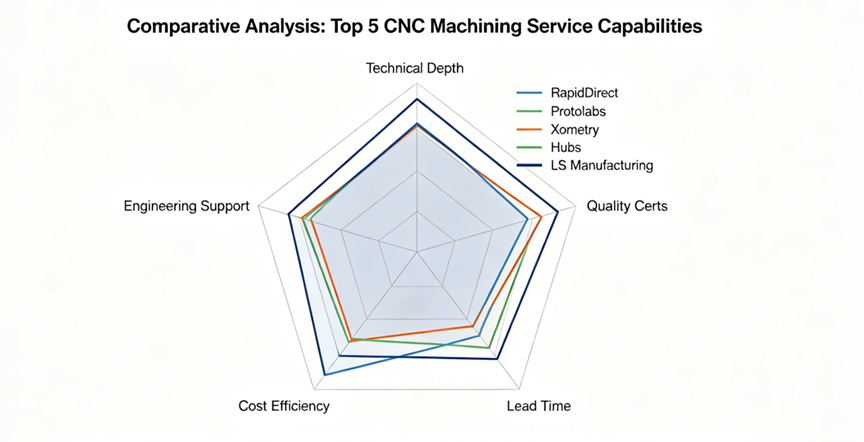
Choosing the correct manufacturing partner involves having knowledge about the industry competition. The following table shows the comparative analysis of the top five international suppliers of CNC machining solutions, based on important criteria for custom CNC machining parts.
| Service Provider | Key Strengths & Focus | Typical Lead Time (Prototyping) | Key Industries Served | Notable Quality Certifications |
| RapidDirect | Online platform, instant quoting, wide material selection. | 1-3 days | Consumer electronics, automotive, robotics. | ISO 9001 |
| Protolabs | Automated quoting, extensive material library, fast-turnaround. | 1-3 days | Medical, aerospace, consumer products. | ISO 9001, ISO 13485 |
| Xometry | Extensive manufacturing network, broad capabilities beyond CNC. | 1-5 days | Aerospace, defense, automotive. | ISO 9001, AS9100 |
| Hubs (a Xometry Co.) | Online platform, global supplier network, accessible pricing. | Varies by partner | General engineering, startups, R&D. | Varies by partner |
| LS Manufacturing | True end-to-end services from DFM to assembly, dedicated project engineering, in-house advanced manufacturing, and rigorous quality control for complex, high-precision components. | 3-5 days | Automotive, Aerospace, Medical Devices, Robotics, Industrial. | ISO 9001:2015, IATF 16949, AS9100D, ISO 13485 |
Although all suppliers provide customized CNC machining services, their level of integration and specialization differs. RapidDirect, Protolabs, and Xometry are particularly adept at providing rapid quotations and deliveries for an extensive range of stock items. Hubs is well-known for enabling customers to leverage its distributed network.
In comparison, LS Manufacturing stands out due to its comprehensive engineering capabilities, having its own smart manufacturing facilities, and possessing the tightest industry standards, including IATF 16949 for automotive components and AS9100D for aerospace applications.
How Does Professional CNC Prototyping Mitigate Mass Production Risk?
CNC prototyping and production is more than an initial step, but an investment to mitigate risk throughout the entire manufacturing process. It acts as proof of concept that checks on several key areas prior to tooling and high-volume production. Firstly, it ensures the CAD file can be machined and assembled successfully without any problems. Secondly, it tests the materials in question in practical conditions – for instance, their performance when subjected to stress, heat, or other chemicals.
Thirdly, it optimizes the machine settings for the part – things like cutting speeds and positioning. This way, it becomes possible to spot potential flaws in terms of fit, function, and performance and fix them before investing too much into mass production – after all, any changes introduced at this stage may result in an exponential increase in costs due to change orders. Therefore, any good custom CNC machining company will use prototypes to eliminate any risks involved in production processes.For a deeper dive into this integrated approach, explore this resource on custom cnc machining service.
How to Evaluate and Select the Right CNC Machining Partner for Your Project?
Choosing an effective CNC machining service provider should involve a systematic assessment process, not only involving cost and time considerations. Some of the factors to consider when choosing an appropriate partner for your manufacturing process include the following. The capability validation is crucial, since it enables you to assess machine capability, understand their experience in machining your kind of parts, and their ability to provide services within the desired tolerance levels.
It is necessary to select suppliers who have some level of quality control through ISO 9001 or even other certificates such as AS9100D and IATF 16949.For projects requiring seamless integration from design to delivery, partnering with a provider offering comprehensive online cnc machining services backed by a robust in-house infrastructure and engineering team can be the decisive factor for success.
Conclusion
This examination of some of the best global precision CNC machining services reveals the importance of a single approach that combines the manufacturing process from design to production. This approach, which involves DFM analysis, risk minimization prototyping, and mass production under control, not only saves on redesign costs but also decreases time to market.
In case you are looking for a precision manufacturing company that will provide you with end-to-end design to production service, then it would be wise to look at the end-to-end capabilities of those providers holding the most stringent quality standards such as ISO 9001, IATF 16949, and AS9100D.
read more : https://seagreen-louse-169149.hostingersite.com/
Author Bio
The author is an expert in the precision manufacturing sector who possesses 15 years’ worth of expertise in advanced manufacturing processes and CNC machining, and has worked in product development and supply chain management for various engineering firms.
H2:FAQs
Q1: What does an end-to-end CNC machining process mean?
A:An end-to-end CNC machining process involves the entire process from consultation, manufacturability, prototype manufacturing, and even mass production to ensure that design accuracy is maintained and that there are no miscommunications in the entire process.
Q2: What level of precision could be achieved using custom CNC machining?
A:LS Manufacturing, one of the best CNC manufacturing firms, can achieve a precision level as high as ±0.005 mm depending on the material and the CNC machining process used.
Q3: Why is CNC prototyping critical during mass production?
A:CNC prototyping helps in detecting any design errors that may have occurred, the kind of materials being used in the fabrication of the parts, and any procedural issues, thus reducing future mistakes in the mass production process.
Q4: How will the quality system of the CNC provider be judged to be reliable?
A:It should be checked whether the supplier has been certified according to relevant industry standards, such as the ISO 9001 Quality Management System, the IATF 16949 Automotive Industry Standard, or the AS9100D Aerospace Certification..
Q5: What is the standard lead time from design to production?
A:The lead time depends upon the project’s nature and complexity. However, end-to-end solutions could cut down the overall duration by 30-50%.
read more : How to Recover Deleted Photos from WhatsApp