
You know the moment. You’re three hours into a spreadsheet that refuses to balance, or halfway through a study session where the words have stopped meaning anything, and suddenly you notice your fingers doing something on their own. Clicking a pen. Peeling the label off a water bottle. Tapping out an entire drum solo on the edge of your desk while your brain quietly panics about a deadline.
Your hands are not being rude. They’re asking for a job.
There’s something almost universal about this. Watch a room full of people during a tense meeting and you’ll see it everywhere — a bracelet being turned, a paperclip bent into abstract art, a leg bouncing under the table like it’s training for something. We are restless creatures with restless hands, and when our minds get stuck, our bodies start looking for somewhere to put the extra energy.
The good news is that this instinct isn’t a flaw to suppress. It’s a lever you can actually pull. And a small, well-made fidget toy sitting on your desk can turn that scattered, twitchy energy into something surprisingly close to focus.
Why Fidgeting Actually Works
Here’s the simple version, without the neuroscience lecture.
When you’re stressed, restless, or bored, your nervous system is producing energy that has nowhere to go. That energy doesn’t just evaporate because you told it to. It leaks out as pen-clicking, nail-biting, doom-scrolling, or that particular flavor of anxiety where you reorganize your entire desk instead of writing the email.
Giving your hands a repetitive, low-stakes physical task does two useful things at once. First, it gives that surplus energy an outlet — a small, harmless place to drain. Second, and more interestingly, it occupies just enough of your attention to stop your mind from wandering off, without occupying so much that you can’t think. It’s the same reason some people think better while walking, or why you have your best ideas in the shower. A little background motion keeps the engine idling instead of stalling.
Think of it like a fan running in a quiet room. It’s not the point. It just makes the silence easier to sit in.
There’s also something genuinely soothing about repetition. The steady spin of a weighted disc, the click of a magnetic slider, the smooth glide of a ball bearing — these are predictable, rhythmic, and completely under your control. When a lot of things in your day are none of those, a small object that does exactly what you expect it to do, every single time, is its own quiet form of reassurance.
Finding the Right Toy for the Right Moment
Not every fidget toy belongs in every situation, and this is where a lot of people go wrong. They buy something delightful, bring it to work, and discover on day one that their entire open-plan floor can hear it.
So let’s break it down by where you actually are.
At the Office: Silence Is a Feature
The office fidget toy has one non-negotiable requirement: nobody else should know you’re using it. This immediately rules out anything that clicks, rattles, snaps, or makes a noise your coworkers will start dreaming about.
What works instead is smooth, continuous motion. Spinning rings that glide on quality bearings. Weighted sliders that move on magnets rather than mechanical stops. Smooth stones or metal objects with satisfying heft that you can simply turn over in your palm during a call. Anything where the pleasure comes from the feel of the movement rather than the sound of it.
The weight matters more than people expect. A cheap plastic spinner feels like nothing — you get almost no feedback, so your hands lose interest in about four seconds. Something with real mass in it gives your fingers something to push against, and that resistance is where the satisfaction lives.
While Studying: Discreet and Undemanding
Study fidgets need to be even more invisible, because you’re often in a library, a lecture hall, or a shared space where the social cost of an unexpected noise is genuinely high.
The other rule for study is that your fidget should not be interesting. This sounds backwards, but it’s important. A toy with puzzles, patterns, or a satisfying “solved” state will eat your attention. You’ll look up and realize you’ve spent eleven minutes solving the same magnetic sequence instead of reading chapter four.
You want boring. Beautifully, reliably boring. Something you can operate with one hand, without looking, while the rest of your brain does the actual work. A simple spinning ring, a smooth worry stone, a slider with one axis of motion — these do the job because they don’t compete for the spotlight.
For Anxiety: Give Your Hands Something Solid
Anxiety is a different animal. Here you’re not trying to focus, you’re trying to come back to your body — to interrupt a spiral of thought with something physical and real.
This is where deeply tactile toys earn their place. Heavier objects. Textured surfaces. Things with a satisfying resistance you have to push through. The key quality is grounding: an object substantial enough that holding it feels like holding something, not like holding air.
Cold metal helps here, oddly. The temperature is a sensory anchor all by itself, and the weight in your palm gives you something to press into when your chest feels tight. Many people find that the slow, deliberate motion of a heavy spinning object — watching it turn, feeling the smooth momentum — does something a squeeze ball never quite manages.
The Desk-Toy Sweet Spot
There’s a whole category of fidget toy that doesn’t hide in your pocket at all, and I’d argue it’s the most enjoyable one to own.
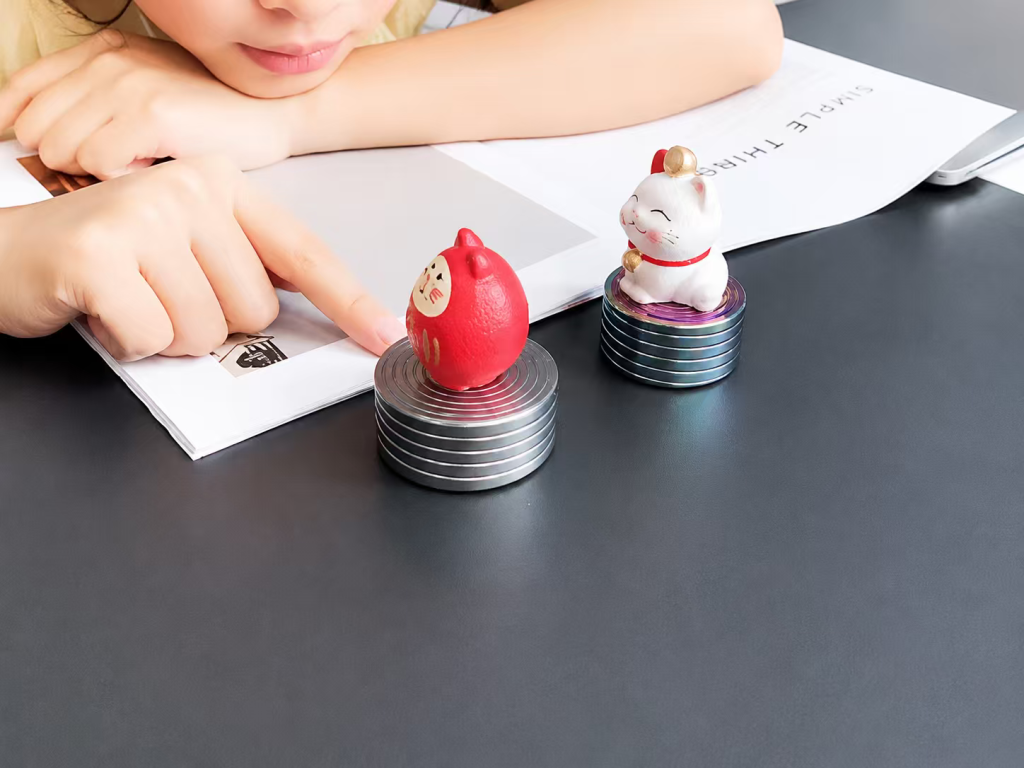
Desk toys live out in the open. They’re objects you can leave next to your monitor, that look like they belong in a well-considered workspace, and that you reach for when you need a moment away from the screen. The best of them do something that’s genuinely pleasant to watch as well as touch — a slow orbit, a suspended spin, a balanced piece of metal turning far longer than seems reasonable.
Well-made kinetic desk toys tend to be the ones people fall for hardest. There’s something almost meditative about a piece that moves smoothly on quality bearings, holding its motion for a minute or more while you sit back and let a problem untangle itself in the background. It’s the modern equivalent of staring out a window, except the window is on your desk and you built the weather yourself.
They also serve a purpose that has nothing to do with stress at all. A good desk toy is a visible signal — to you, mostly — that this is a place where thinking happens. That small ritual of setting something spinning before you start a difficult task is a surprisingly effective way of telling your brain the session has begun.
And unlike a coffee, you can do it four times an hour.
What Makes One Actually Worth Keeping
Most fidget toys are disposable. You know this because you’ve probably bought one, enjoyed it for a week, and then found it at the bottom of a drawer with a snapped hinge and a bearing that’s started making a noise like a dying insect.
The difference between a toy you use for a week and one you use for years comes down to a handful of things.
- The bearing. This is the entire soul of a spinning toy. A cheap bearing feels gritty from day one and gets worse. A good one glides, holds momentum, and stays smooth for years. If a spinning toy feels rough in the first ten seconds, it will never feel better than that.
- The weight. Real mass — brass, steel, titanium, dense alloys — gives you feedback your fingers can actually read. Lightweight plastic gives you nothing.
- The motion. It should feel intentional. Smooth, damped, without wobble or slop. You’ll know within one turn.
- The build. Tight tolerances, clean finishing, no rattle where there shouldn’t be one. Parts that fit like they were made for each other, because they were.
- The silence. Quality construction is naturally quieter. Noise in a mechanism is usually a sign of parts that don’t fit properly.
None of this requires spending a fortune. It just requires caring about the difference between an object designed to be used and one designed to be sold. If you’re looking for a place to start, browsing well-crafted stress relief fidget toys from makers who take the engineering seriously — LYWJ among them — will tell you very quickly what the good stuff feels like compared to the throwaway bin at the checkout counter.
Buy one thing that lasts instead of five things that don’t. Your desk drawer will thank you.
Desk Etiquette: How Not to Become That Person
Every office has one. The person whose fidget toy has become a shared trauma.
Don’t be them. A few practical rules make this easy.
Test the noise before you commit. Not in the shop, where there’s music playing — at home, in a quiet room, at the volume a silent office actually operates at. If you can hear it clearly from three feet away, it stays home.
Keep it below the desk line when you can. Most fidgeting works perfectly well out of sight, and the visual movement is often more distracting to people nearby than the sound. Something in your lap or beside your keyboard, half-hidden, is invisible to everyone but you.
Read the room during meetings. Fidgeting can help you listen, genuinely — but it can also read as disengagement to someone who doesn’t know that. A discreet motion under the table is fine. Spinning something on the conference table while your manager talks about Q3 is a conversation you don’t need to have.
Have a backup that’s completely silent. A smooth stone, a weighted ring, a simple metal object with nothing that moves at all. For the moments when even a whisper of sound would be wrong.
And be a little generous about other people’s fidgeting, too. What sounds like restlessness is very often someone doing exactly what they need to do to stay present in the room with you.
Small Object, Real Difference
None of this is going to fix a genuinely bad week. A fidget toy isn’t therapy, and anyone who tells you a spinning piece of brass will cure your anxiety is selling something.
But it does something smaller and more honest. It gives your hands a place to be. It takes the low hum of restlessness that follows you through a long afternoon and turns it into a smooth, quiet motion you actually enjoy. It gives you a reason to look away from the screen for thirty seconds without reaching for your phone. And on the days when your thoughts won’t settle, it hands you something solid and real to hold onto.
That’s not nothing. That’s genuinely useful, most days.
So if you’ve been clicking the same pen for the last two years, maybe it’s worth finding something better — something with real weight, a bearing that glides, a motion you look forward to. Keep it by your keyboard. Reach for it when the sentence won’t come or the meeting drags. Let your hands do their thing.
The work goes easier when they’re busy.


